The Ultimate Beginner’s Guide: How to Make a Bubbly Sourdough Starter From Scratch (Step-by-Step)
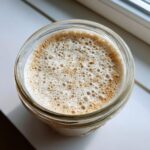
Learn how to create your own active sourdough starter using only flour and water. This easy, day-by-day guide is perfect for the first time sourdough baker wanting to master natural leavening.
- Prep Time: 5 min daily
- Cook Time: 0 min
- Total Time: 7 days (active creation period)
- Yield: One active culture
- Category: Baking Foundation
- Method: Natural Fermentation
- Cuisine: American
- Diet: Vegetarian
Ingredients
Scale
- 100g Whole Wheat Flour or Rye Flour (for initial activation)
- 100g Unbleached All-Purpose Flour (for subsequent feedings)
- 100g Unchlorinated Water (room temperature)
Instructions
- Day 1: Mix 50g of whole wheat or rye flour with 50g of room temperature water in a clean jar. Stir until fully combined. Cover loosely and leave at room temperature (ideally 70-75°F) for 24 hours.
- Day 2: You may see small bubbles or no activity. Discard half of the mixture. Add 50g of all-purpose flour and 50g of water to the remaining starter. Mix well, cover loosely, and wait 24 hours.
- Day 3: You should see some activity now. Discard half. Feed with 50g of all-purpose flour and 50g of water. Mix and wait 24 hours.
- Day 4: Discard half. Feed with 50g of all-purpose flour and 50g of water. If your kitchen is cool, you may need to wait 24-36 hours between feedings.
- Day 5: Continue discarding half and feeding with 50g of all-purpose flour and 50g of water every 12 to 24 hours. The starter should begin to double in size predictably after feeding.
- Day 6 & 7: Your sourdough starter should now be reliably doubling in size within 4 to 8 hours after feeding, showing many bubbles, and smelling pleasantly sour. This is an active sourdough starter ready for baking.
- Maintenance: Once active, switch to feeding once daily if kept at room temperature, or once a week if stored in the refrigerator. Always use equal parts starter, flour, and water for feeding (a 1:1:1 ratio by weight).
Notes
- Use filtered or bottled water if your tap water contains chlorine, as chlorine can slow down the wild yeast growth.
- A consistent temperature helps fermentation. If your kitchen is cold (below 68°F), place the jar in a slightly warmer spot, like near a pilot light or inside an oven with just the light on.
- When you are ready to bake artisan bread, feed your starter 4-12 hours before you plan to mix your dough. You want it to be at its peak activity (doubled and very bubbly).
Nutrition
- Serving Size: N/A (Culture)
- Calories: 10
- Sugar: 0.1
- Sodium: 0
- Fat: 0.1
- Saturated Fat: 0
- Unsaturated Fat: 0
- Trans Fat: 0
- Carbohydrates: 2
- Fiber: 0.2
- Protein: 0.5
- Cholesterol: 0